
Beyond P50: Insights at WindEurope 2026 on AI and the Future of Wind Operations
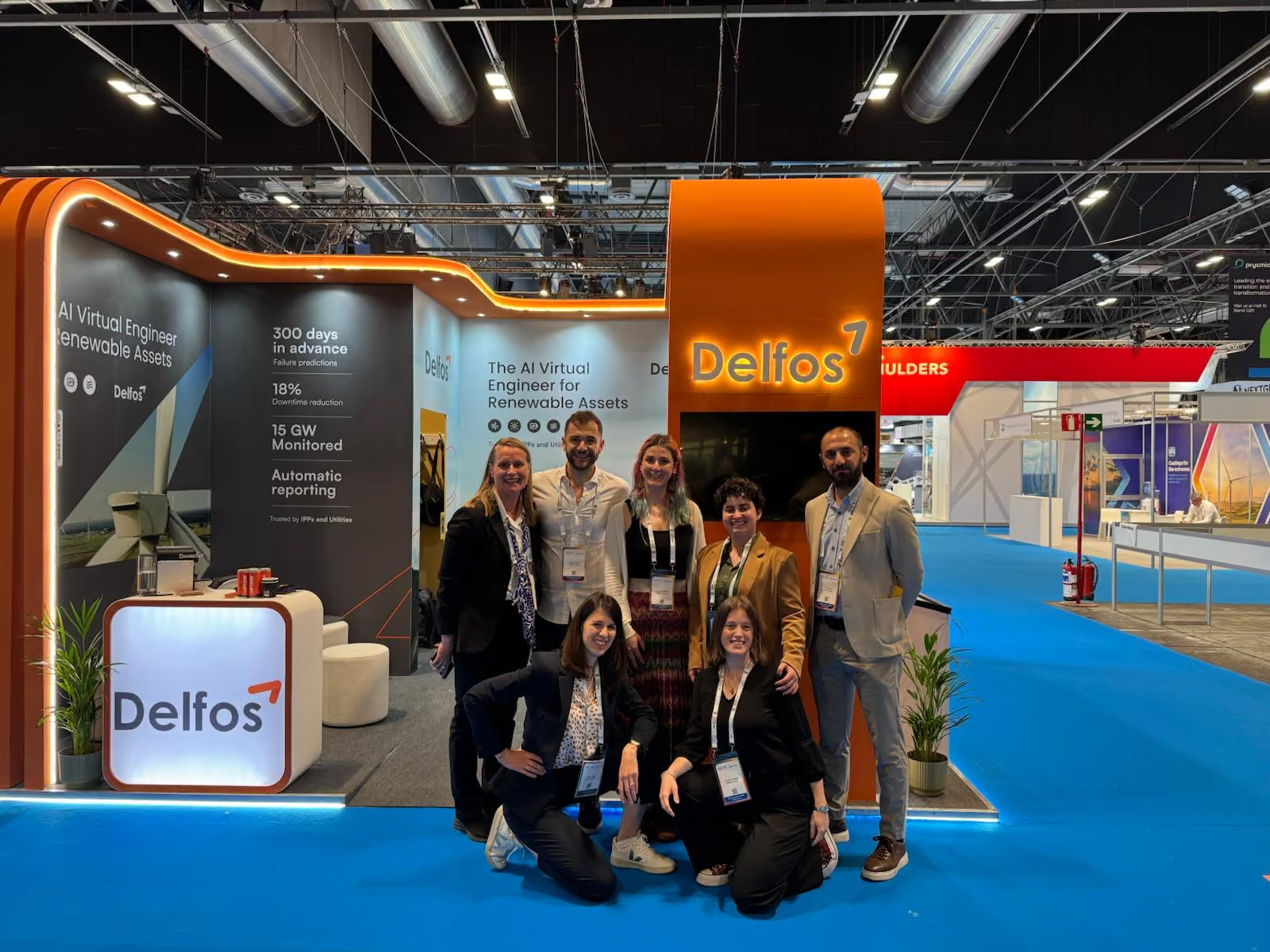
In the innovation landscape of WindEurope 2026, one central question shaped the discussions: why do modern wind farms, equipped with cutting-edge technology, still struggle to reach their production targets?
The so-called P50 gap has moved beyond being a technical detail. It has become a critical financial challenge. As Nathianne Andrade showed, this gap, the Reality Gap, affects not only engineering performance, but also the economic viability, LCOE, and return on investment of renewable assets.
Nathianne, who currently leads the Data Science and Renewable Energy Analytics front at Delfos Energy, presented a clear view of how Artificial Intelligence is closing this gap by transforming raw data into intelligent execution and protecting revenue across global portfolios.
Lesson 1: P50 is not just a design problem. It is an operational reality.
Historically, the sector has attributed underperformance to resource overestimation during the design phase. Today, however, the industry must recognize that risk has shifted from design to Operational Reality.
The danger of “flying blind,” without deep visibility into losses, turns strategic asset management into a reactive firefighting exercise.
Andrade highlighted four pillars of loss that erode P50:
- Availability and Downtime: interruptions that silence turbines.
- Environmental Conditions: external variables that impact the asset’s real behavior.
- External Curtailment: grid restrictions that limit energy delivery.
- Subsystem Underperformance: hidden inefficiencies in critical components.
Ignoring these pillars, especially power curve underperformance, prevents operators from identifying failures in time to request contractual reviews with manufacturers, putting the asset’s financial health at risk.
Lesson 2: The Scale Challenge: the end of the “one engineer per turbine” era
Scalability has changed the rules of the game.
What works for one engineer monitoring one turbine breaks down completely when the ratio becomes one engineer for every 100 turbines. The volume of data generated today exceeds any human capacity for manual analysis.
Delfos’ answer to this scale challenge is significant: the platform keeps more than 40,000 active Machine Learning models, processing data every 10 minutes.
In a market that demands greater reliability without allowing teams to grow at the same pace, AI is the only tool capable of keeping performance engineering teams lean while making them highly effective.
Lesson 3: Elevating the SCADA Baseline: intelligence vs. data volume
Traditional SCADA is the foundation. But to secure P50 targets, the industry needs a second layer of intelligence.
Delfos’ Operational AI filters the noise and focuses on what drives revenue. As the Alupar team stated:
“We are solving problems faster and seeing better revenue. Managing assets has become simple.”
Below are the key differences that separate traditional monitoring from next-generation AI:
- Data Handling: SCADA delivers massive volumes of unfiltered data. AI applies intelligent filtering and asset prioritization.
- Alert Strategy: from alarm fatigue to early-warning predictive alerts.
- Visibility: from system-level visibility only, with SCADA, to deep subsystem diagnostics, with Delfos AI.
- Operational Mode: from reactive firefighting to proactive revenue recovery.
Lesson 4: The Science of Prediction: 9,627 MWh in avoided losses
Delfos’ failure detection is not based on static rules. It learns the normal behavior of each component, such as the generator, gearbox and pitch system.
When the system detects a deviation between the real value and the value predicted by the Machine Learning model, a predictive alarm is generated.
The economic impact is clear.
In a case study involving 155 WTGs, focused on main bearings, one of the most critical and expensive components, the methodology reached 100% recall and 95.19% precision.
The practical results from only five months of monitoring in a real fleet included:
- 9,627 MWh in avoided losses, recovering 2.3% of annual production.
- €770,000 in protected annual value.
- Failures solved through minor maintenance actions, eliminating the need for major component replacements.
This science can provide up to 330 days of maximum advance warning, enough time to plan interventions and avoid the financial collapse of the asset.
Lesson 5: The AI-Native Operator: conversations instead of dashboards
Nathianne Andrade presented a vision in which the future of operations is not in complex dashboards, but in conversational interfaces, powered by LLMs.
The AI-Native operator works through three pillars:
- Ask: query any dataset in natural language, without waiting for manual reports.
- Recall: instantly identify past failures and the solutions that worked, keeping fleet knowledge inside the tool and reducing the risk of knowledge loss caused by staff turnover.
- Decide: receive maintenance recommendations based on the accumulated knowledge of the entire fleet.
This approach closes the intelligence gap. As portfolios grow, tools carry the weight of analysis, not massive hiring.
The Next Level of Asset Management
Human-AI collaboration is not about replacing engineering. It is about amplifying it.
By transforming raw data into intelligent execution, companies break the reactive cycle and focus on tangible results.
For leaders looking to move ahead in the sector, one question remains:
Your fleet is growing. But is your ability to understand every loss growing at the same pace, or are you still trapped in a reactive cycle?
Meet Delfos
It is time to eliminate the reality gap in your assets with a company already monitoring more than 15 GW globally.
What once sounded futuristic is now part of the daily operations of leaders such as Renova, Alupar and Finlight.
Explore how Delfos helps renewable energy teams recover performance, anticipate failures and protect revenue across their portfolios.
Discover the recovery potential of your assets with our Energy Loss Calculator or schedule a conversation with our team.
Reserva una reunión
Conectemos y forjemos nuevas asociaciones

Custom Renewable Energy Solutions
Póngase en contacto con nosotros hoy mismo para hablar sobre sus necesidades de energía renovable y encontrar la solución perfecta para su empresa.