
Renewable Energy Asset Management: Balancing Grid Volatility and Multi-Market Integration
Operational Realities in Modern Power Markets
The clean energy sector has transitioned away from static operational models. Driven by a historic $2.2 trillion capital influx and a 140% surge in global capacity built between 2015 and 2025, renewable energy assets now generate 33.8% of global electricity, according to the Ember Global Electricity Review. Technology gains have reduced solar lifecycle costs by 99% since the 1970s, making renewables a highly cost-efficient power source.
However, this rapid growth introduces localized grid oversupply and frequent negative price events. According to Pär Dunder, Senior Advisor and Director, the industry has reached a pivotal juncture where long-term transition strategies must pivot toward managing immediate, physical system pressures:
"The long-term transition narratives, the plans we have had for a long-term transition into more renewables, have partly been changed into handling immediate structural pressure and stress."
— Pär Dunder, Senior Advisor & Director at Affärsliv W3 AB.
To maintain portfolio returns, operators are transitioning away from simple, volume-based generation toward flexible, intelligent asset infrastructure.
Market Integration and Algorithmic Execution
Preserving profitability amid fluctuating power prices requires combining wind, solar, and battery storage into unified hybrid operating profiles. Coordinated physical generation and storage allows operators to participate simultaneously across several power and capacity markets.
Regulatory structures are shifting to accommodate closer-to-delivery trading. For example, as outlined by the Swedish TSO Svenska kraftnät, by the end of March 2027 the Swedish Transmission System Operator (TSO) will compress its intraday gate closure window from 60 minutes down to 30 minutes prior to physical delivery. Kruno Kuljis, Head of Market Analysis at Modity, notes that this compressed timeline will fundamentally alter how operators handle daily imbalances:
"In 2027 the Swedish TSO will change the regime to be able to trade 30 minutes into the delivery. So that will be better for renewables to deal with imbalances and changes or outages, but also using the arbitrage to be able to deal with these changes of the market."
— Kruno Kuljis, Head of Market Analysis at Modity.
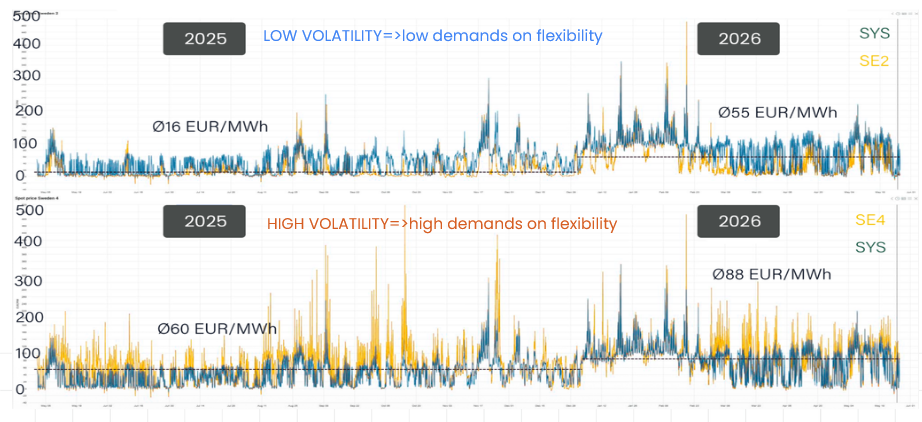
Concurrently, European market integration across the automated Frequency Restoration Reserve (aFRR/PICASSO) and manual (mFRR/MARI) balancing platforms exposes operators to pricing volatility, with transitional bid limits reaching ± €15,000 per megawatt-hour. Navigating these narrow trading windows requires automated trading algorithms capable of parsing continuous SCADA data streams.
The Role of Continuous Performance Monitoring
Relying on standard office-hour monitoring introduces substantial operational risk. Because power grids function continuously, modern asset management demands 24/7 oversight. Eva Liljendahl, Delfos Energy Specialist, emphasizes that an artificial intelligence layer—acting as a virtual engineer—is critical for modern system health:
"A virtual engineer is actually necessary to secure energy production and system health, enabling up to an 18% cut in downtime for the different assets, keeping unavailability to under 2%, and increasing production up to 6%."
— Eva Liljendahl, Delfos Energy specialist.
Meteorological Drivers and Hydrological Variability
Weather patterns remain the primary driver of physical generation and pricing structures. For instance, a 25 terawatt-hour hydrological deficit across Norway and Sweden recently caused sustained upward pressure on regional Nordic electricity prices.
As noted by market analyst Kruno Kuljis, seasonal transitions, such as the formation of El Niño Southern Oscillation (ENSO) patterns, alter the behavior of low-pressure systems across the Atlantic and directly impact generation. During summer periods, high-temperature heatwaves across central Europe combined with reduced wind output often lead to localized price spikes. Conversely, autumn and winter systems influenced by El Niño introduce heavy precipitation and sustained winds.
As highlighted in the executive panel discussion, older, defensive risk-handling methods — such as abrupt high-wind cut-out and shutdown hysteresis — can inadvertently reduce total wind power output, creating artificial shortages during critical operational windows. Modern asset performance requires combining predictive weather modeling with real-time mechanical health data to optimize output without subjecting equipment to structural stress.
Core Pillars of Contemporary Asset Management
Successfully converting grid and market challenges into predictable corporate returns relies on three core operational pillars outlined by Pär Dunder, Senior Advisor & Director: Data, Control, and Collaboration.
Global capital allocations reflect these priorities. According to data highlighted by Pär Dunder, financial backing is increasingly favoring battery storage, smart grid infrastructure, and AI-driven asset performance software over uncoordinated generation assets. Operators deploying advanced predictive analytics routinely see measurable performance improvements, including reducing asset downtime by up to 18%, limiting unexpected unavailability to under 2%, and increasing overall annual energy production by up to 6%.
Ready to optimize your portfolio?
The insights in this article were developed from the comprehensive executive briefing panel, Renewables Asset Management: A Journey Through Complexity and Collaboration for a Brave, Profitable Future, featuring Eva Liljendahl (Delfos Energy), Kruno Kuljis (Modity), and Pär Dunder (Affärsliv W3 AB).
Click here or check the video below to watch the complete recorded executive panel briefing and download the comprehensive presentation materials, historical pricing models, and complete meteorological data sets.
Book a meeting
Let's connect and forge new partnerships

Custom Renewable Energy Solutions
Contact us today and join global operators who recovered up to 10% revenue and cut downtime by 18%